
The Supreme Court of India has struck down key provisions of the 2021 Tribunals Reforms law, citing violations of separation of powers and judicial independence. The court restored earlier directions on tenure for tribunal members.
An advocate has requested the Attorney General's consent to initiate criminal contempt proceedings against a lawyer who attempted to throw a shoe at the Chief Justice of India in the courtroom. The incident involved shouting religious slogans and led to the lawyer's suspension.

The Supreme Court has directed the removal of all cattle and other stray animals from highways and expressways, citing safety concerns and frequent accidents.
In the order stated by the trial court 25 years ago, a decree was made according to the principle of primogeniture in which the successor of the ruler was entrusted with all private properties.

Union Environment Minister Bhupender Yadav accuses the Congress of spreading misinformation regarding the new definition of the Aravallis and defends the government's commitment to protecting the mountain range while allowing limited, legal mining.

'Grassroots-level corruption, which disrupts the last-mile work, cannot be ignored in your enthusiasm and drive to get going to complete the project.' 'Like it was in MGNREGA, in some states, it is the case with the Jal Jeevan mission.' 'The last minute levels of corruption can ruin the intent of the project itself.' 'When you see that people can game a particular well-intended and well-crafted project, you need to correct that.'
The ruling means no fresh elections will be held, a move vital for Indian football since a mid-term poll could have triggered FIFA's wrath and another suspension for "third-party interference."
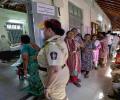
The Supreme Court has addressed the issue of reservation quotas in Maharashtra local body elections, stating that the final results of elections in 57 local bodies, where the 50% quota ceiling has been breached, will depend on its judgment in the case.

Justice Surya Kant is set to become the 53rd Chief Justice of India, bringing extensive experience and a record of significant verdicts on key issues.

A lawyer allegedly attempted to throw a shoe at Chief Justice of India BR Gavai during court proceedings. Security intervened, and the lawyer was removed from the premises. The CJI remained composed and continued with the proceedings.
The application sought direction for 'X' to take down the video immediately to prevent further communal disharmony.
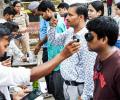
The Supreme Court has directed the Union Public Service Commission (UPSC) to incorporate provisions for scribe changes and implement screen-reader software for visually-impaired candidates in its examinations. The court emphasized the constitutional rights of differently-abled people and the need for inclusive governance.
Supreme Court judge Surya Kant expressed his reluctance to order urgent listing of cases on the same day, except in extreme circumstances, highlighting the workload and sleep deprivation of judges.

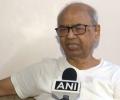
Speaking to ANI on Tuesday, Rakesh Kishore said that he was hurt by the CJI's remarks while dismissing a plea seeking restoration of the structure of Lord Vishnu in the Javari temple in Khajuraho.

The Madhya Pradesh High Court dismissed a petition seeking a stay on the release of the Hindi film 'Haq', which is inspired by the life and legal struggle of Shah Bano Begum. The court found the petition devoid of merit, clearing the way for the film's release.

Vijay, despite the loud message from his delayed arrival at the road-show/stampede venue, and more so his continued inaccessibility for fans-turned-cadres after graduating from a super-star to a political party leader with electoral ambitions, refuses to change. Or, so it seems, observes N Sathiya Moorthy.

The Cabinet on Tuesday approved the Terms of Reference (ToR) of the 8th Pay Commission, which is likely to be implemented from January 1, 2026.

Indian football remained in a state of terminal decline after experiencing arguably its darkest phase in a year marked by severe administrative crisis, court hearings, financial issues, absence of domestic leagues, and a steep decline in performance of the senior men's team.
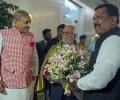
'His willingness to take the initiative to fight for truth and justice and his willingness to cross swords with anyone for a just cause.'
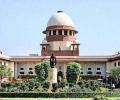
A bench of Justices Abhay S Oka and Ujjal Bhuyan said when an accused appears before a court in pursuance of a summons, the agency will have to apply to the court concerned to get his custody.
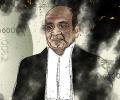
'If the parliamentary committee's report does not find substantiated charges, the process ends.'
A five-judge Constitution bench of the Supreme Court is scheduled to consider the Presidential reference on whether timelines could be imposed by judicial orders for the exercise of discretion by the President while dealing with bills passed by state assemblies.

Tamil Nadu's ruling DMK has filed a petition in the Supreme Court challenging the Election Commission's plan to implement the Special Intensive Revision of electoral rolls in the state.

Complying with the directives of the International Olympic Committee, the IOA on Monday constituted the Indian Court of Arbitration for Sports to settle all sports-related disputes in the country.

A profile of B Sudershan Reddy, former Supreme Court judge and Opposition's vice presidential candidate, highlighting his career, judgments, and contributions to constitutional law.
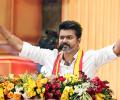
The Election Commission of India informed the Madras High Court that actor Vijay's TVK is not a recognised political party during a hearing regarding a PIL seeking its derecognition following a stampede at a party rally.

'Even if this Bill passes in Parliament, it will reasonably face judicial scrutiny. 'One can reasonably expect challenges in the Supreme Court questioning its Constitutional validity.'
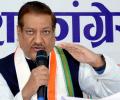
Why will I apologise? It is out of the question. The Constitution gives me the right to ask questions.

India thus topped the list for a third consecutive year, something that might hurt its chances when the International Olympic Committee (IOC) evaluates its bid to host the 2036 Olympic Games in the near future.
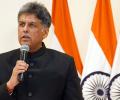
Congress MP Manish Tewari has introduced a bill in Lok Sabha that seeks to allow parliamentarians to take an independent line in voting on bills and motions other than those affecting the government's stability in a bid to free them from "whip-driven tyranny" and promote "good lawmaking".

Opposition leaders on Tuesday demanded a debate on the Constitution in both Houses of Parliament, stressing it was needed in the light of the recent developments in the country.

A bench comprising Justices Sanjiv Khanna and Sanjay Kumar passed the remark while hearing a batch of petitions filed by former Rajya Sabha MP Subramanian Swamy, advocate Vishnu Shankar Jain and others, who have challenged the inclusion of words "socialist" and "secular" in the Preamble of the Constitution.

Former Supreme Court judge B Sudhershan Reddy is the joint candidate of the Opposition parties for the Vice-Presidential polls, Congress President Mallikarjun Kharge announced.

The Supreme Court has agreed to reexamine the case of a death row convict punished for raping and killing a minor in 2008, focusing on whether sentencing guidelines were properly followed.

The Supreme Court has agreed to hear a plea challenging the Karnataka government's decision to invite International Booker Prize winner Banu Mushtaq to inaugurate Mysuru Dasara this year. The controversy stems from allegations that Mushtaq made statements in the past that are perceived by some as "anti-Hindu" and "anti-Kannada".

Today's situation in the Shaksgam Valley is the consequence of what happened in Gilgit in 1947. But is India ready to militarily get back its territories? asks Claude Arpi.
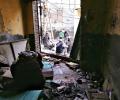
Delhi Police strongly opposes bail pleas of activists Umar Khalid, Sharjeel Imam, and others in the February 2020 riots case, claiming it was a pre-planned attack on the nation's sovereignty and an attempt to divide society on communal lines.

'Repeated adjournments are one of the largest contributors to lengthy litigation cycles.'

'The jurisprudence of a modern secular State has to be strictly rational.' 'Rather than aastha and aqeedah, our jurisprudence as well as the executive and legislature have to act in accordance with Constitutional rationality,' argues Mohammad Sajjad.

A panel headed by PM Modi and including Rahul Gandhi will meet to decide on the next Chief Information Commissioner and information commissioners for vacant positions at the Central Information Commission (CIC).
